Let’s explore the green zone
I expect that most of you working in education will have come across the idea of using colour coded systems to support emotional awareness. Usually, green is the colour that indicates calm, happy or ok. A common example is in the Zones of Regulation programme, which uses blue, green, yellow and red colours to indicate different states of arousal and the subsequent emotions. Somewhere along the way green has been associated in many cases with being ‘good’ and the most desirable state. However, as I mentioned in my article on self-regulation, in reality none of us are regulated 100% of the time.
I want to unpack that properly here by exploring the question: Should we always be expecting the green zone?
In this article, I’ll cover
When adults aren’t green
Let’s start by thinking about our own experiences through the day, week and years of our life as adults. We all have experiences when we aren’t in the green zone. Think about the last time something knocked you properly off balance. A pet dying. Getting difficult feedback on a piece of work you’d poured hours into. Being physically unwell, running on empty, with nothing left in the tank. Something, or someone, making you genuinely angry.
None of these are unusual. They’re just life. And in every one of these situations, feeling low, hurt, exhausted or angry isn’t a sign that something has gone wrong with you. It’s an accurate, proportionate response to what’s actually happening. Nobody expects a grieving friend to be back to their usual cheerful self within the hour. Nobody expects you to shrug off harsh feedback on something you cared about, or to feel bright and breezy when you haven’t slept well or if you have the flu.
If we don’t expect this of ourselves, or of other adults, it’s worth asking why we sometimes expect it of children.
So why do we expect it of children?
Somewhere in how we teach regulation, green can start to sound like the correct answer, the one that gets a nod of approval, a sticker, or the one that garners less attention and means you don’t stand out. Yellow and red, meanwhile, can start to feel like the wrong answer: the one that gets you sent out, or talked to, or potentially in trouble.
This isn’t usually intentional. Most adults using colour-coded regulation tools genuinely want to help children recognise and manage their feelings. But children are extremely good at reading what gets rewarded, and if calm is consistently praised while distress is consistently managed as a problem, the lesson a child takes away isn’t ‘all feelings are welcome’. It’s ‘green is what I’m supposed to say’. In some cases, this can have the unintended consequence of teaching children to hide or mask their true feelings or internal experience.

When green becomes the right answer
Once a child has learned that green is the right answer, something important starts to happen: they can begin performing regulation rather than experiencing it. A child asked how they’re feeling learns to give the answer that ends the conversation, not necessarily the accurate one.
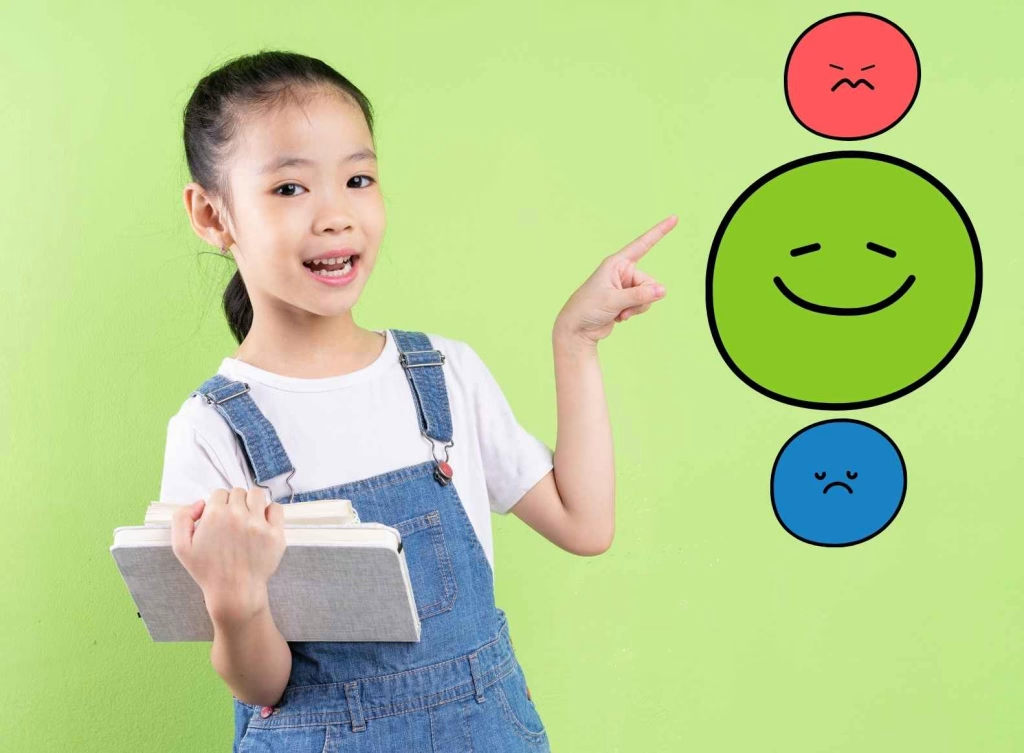
For example, at first glance the girl in this picture is suggesting she is ok. On the surface, she’s giving a thumbs up and smiling. However, if you look closer, her jaw is tight and her smile looks performative. It’s pretend, one of those fake smiles you make when you’re told to smile for the camera. She looks like she is giving the answer that she feels she is expected to give, rather than describing her actual internal state honestly. I see this all the time in schools, children come in and put their face on the green zone, yet their bodies are clearly giving a different signal. If we are honest, we do this ourselves as adults through the day too. How many times do we say we are ‘fine’ when actually our insides might be in turmoil.
What message are we sending?
This is exactly what can happen once green becomes the expected, rewarded answer. A child’s words and gestures say one thing, while their jaw, shoulders, breathing or eye contact say something else entirely. If we only listen to the words, we miss the information that actually tells us how a child is doing. And we need to be very careful about reinforcing this message. We need to ensure when we are teaching children emotional literacy that we are prepared to honour and be ready to support all of their internal states.
What are we teaching, without meaning to?
Colour-based emotional regulation programmes can be genuinely helpful for building a shared vocabulary around arousal levels and emotions. But how we use them, and what we model alongside them, matters just as much as the tool itself. If a child is only ever praised for green, they may be unintendedly taught to mask. As parents, therapist and teachers, I think it’s important to reflect on the following questions when we are using these or other systems to teach emotional and self-regulation.
Colours vs arousal and sensation
Firstly, it’s important to think about the messages we are giving about the colours themselves:
- Are we teaching them about arousal, or are we just teaching colours?
- Do they understand what regulated feels like in their body?
- And what high and low arousal feel like?
- Can they tell when their body is starting to dysregulate and feel a bit uncomfortable?
- Or do they only notice when they are completely dysregulated?
- Are we helping them to know what strategies they can use to move between different arousal states?
- And how to stay safe if they are dysregulated?
Some of the newer autism publications, written by autistic authors, encourage us to describe body behaviours rather than emotions. So, rather than saying ‘You look angry’, describing that you can see the child is stomping their feet and scowling. The reason for this is we can only use behaviours to make a guess about the underlying emotion. Consequently, we may mis-label the emotion. For example, some people laugh and giggle when they are nervous, so this could incorrectly be ladled as happy or excited.
Acknowledging all emotions
Secondly, we need to think about the message we are teachings a whole about emotions:
- Are we teaching our children about the full spectrum of emotions?
- Do they know that all emotions are acceptable?
- Can they identify and name different emotions?
- Do they know what these emotions feel like in their body?
- Have they got a range of strategies they can use to stay safe when experiencing heightened emotions?
Moving beyond the green zone
Ultimately, as adults we need to remember that we all have difficult moments. We also have times when we experience immense joy (or the yellow/red zones of joy). They can be just as intense as the difficult times, but we would never wish for them to go away. Yet many colour-based emotional regulation programmes place these states (e.g. over excited) into the yellow and red zones. This can sometimes automatically classify them as negative states. Do we really want that to be the case? I would guess not, but it can sometimes be an unintended consequence when colour-based systems aren’t taught effectively.
In my mind, children don’t need to learn that green is good and everything else needs fixing. They need to learn that every feeling, and every zone, is allowed. What really matters is what we do while we’re there: staying safe, and staying respectful of the people around us, even when we’re yellow, red, or a shade of blue we don’t have a name for.
That means our focus, as adults, should shift. Instead of steering children back to green as fast as possible, or treating an honest ‘I’m not okay’ as a problem to solve immediately, we can help them build a genuine toolkit of strategies for navigating whatever feeling they’re actually experiencing. Ultimately, regulation isn’t about permanently living in green. It’s about having the skills, and the safety, to move through every colour and come back out the other side.
We need to ensure that we are supporting children to know the whole spectrum of arousal and emotions that they experience are normal and ok. There is so much more to self-regulation than just aiming for the green zone.
Quick fire questions: The green zone
Isn’t the whole point of Zones of Regulation to help children get back to green?
Definitely not! The tool is meant to build a shared language for identifying arousal level and naming feelings. It’s not designed to rank one zone above the others and the manual explicitly teaches all zones are ok. Getting back to green matters far less than a child being able to identify their internal state and them being safe, respectful and equipped with strategies they use to manage whichever zone they’re in.
How do I respond when a child says they’re fine but clearly isn’t?
Gently name what you’re noticing, rather than accepting the words at face value. Something like ‘You’re saying you’re okay, but your shoulders look really tense, want to tell me about it?’ lets a child know you’re paying attention to more than their answer, without calling them out for masking. There is a growing body of academics indicating that naming the physical characteristics you see, such as tone of voice, or body movements, can be more helpful, especially for neurodiverse children than naming the emotion. This is because sometimes we get the emotion wrong!
Won’t accepting every feeling lead to more disruptive behaviour?
Accepting a feeling and accepting any behaviour are two different things. A child can be furious and still be expected to stay safe and respectful. Helping children to understand feelings, which are always valid, are separate from the behaviour, which still has boundaries, is essential. This is where it’s important for adults to set clear boundaries and expectations of safe behaviour from early on. It’s also important for adults to model safe and respectful behaviour when they are dysregulated themselves.
About the author
All articles on the GriffinOT website are written by children’s occupational therapist Kim Griffin. Kim has over 25 years’ experience supporting children with sensory and skill needs, their teachers and families. She is the author of multiple books, presents all training at GriffinOT and hosts the EBPOT podcast. Kim is currently completing her PhD, focussing on supporting children’s self-regulation in schools, at Oxford Brookes University. You can view Kim’s academic publications on her ORCID profile, or Google Scholar page.
Date last updated by Kim: 31st August 2026
Other Articles You Might Be Interested In