
Let’s explore self-regulation
What is self-regulation? Ask a teacher, a psychologist and an occupational therapist, and you’ll likely get three different answers. This is not because one of them is wrong. It is because self-regulation is one of those terms that gets used constantly, and defined differently, across a huge range of disciplines.
This is the third article in my three-part series on regulation. Having covered what regulation is, and how co-regulation supports its development, I want to unpick self-regulation itself. I’ll consider what it includes, how it develops, and why we shouldn’t expect anyone, child or adult, to manage it perfectly all the time.
In this article, I’ll explore

Let’s explore self-regulation
What is self-regulation? Ask a teacher, a psychologist and an occupational therapist, and you’ll likely get three different answers. This is not because one of them is wrong. It is because self-regulation is one of those terms that gets used constantly, and defined differently, across a huge range of disciplines.
This is the third article in my three-part series on regulation. Having covered what regulation is, and how co-regulation supports its development, I want to unpick self-regulation itself: what it includes, how it develops, and why we shouldn’t expect anyone, child or adult, to manage it perfectly all the time.
In this article, I’ll explore
Why self-regulation means different things to different people
The academic literature on self-regulation is genuinely messy. One recent review identified 477 different terms used to describe it. Across a handful of studies, somewhere between roughly 43% and 64% of authors used the term without ever properly defining what they meant by it, and over a third of researchers turned out to be studying a different skill entirely, despite using the same word. If you’ve ever come away from a training session unsure exactly what self-regulation means, you’re in good company.
Part of the reason for this is that different disciplines have grown up looking at different pieces of the puzzle. Psychologists have tended to focus on executive function, the cognitive skills involved in planning, inhibiting and shifting attention. Occupational therapists, sometimes look through a sensory integration lens, focusing on how the body processes and responds to sensation. Educators have tended to focus on metacognition and self-regulated learning: how a child manages their own thinking and behaviour to meet a learning goal.
None of these views is wrong, and each is informed by different theoretical models and professional training. But when we only use one lens, we miss the rest of the picture, and this is part of why self-regulation can feel so hard to pin down, and so hard to teach.
The domains of self-regulation
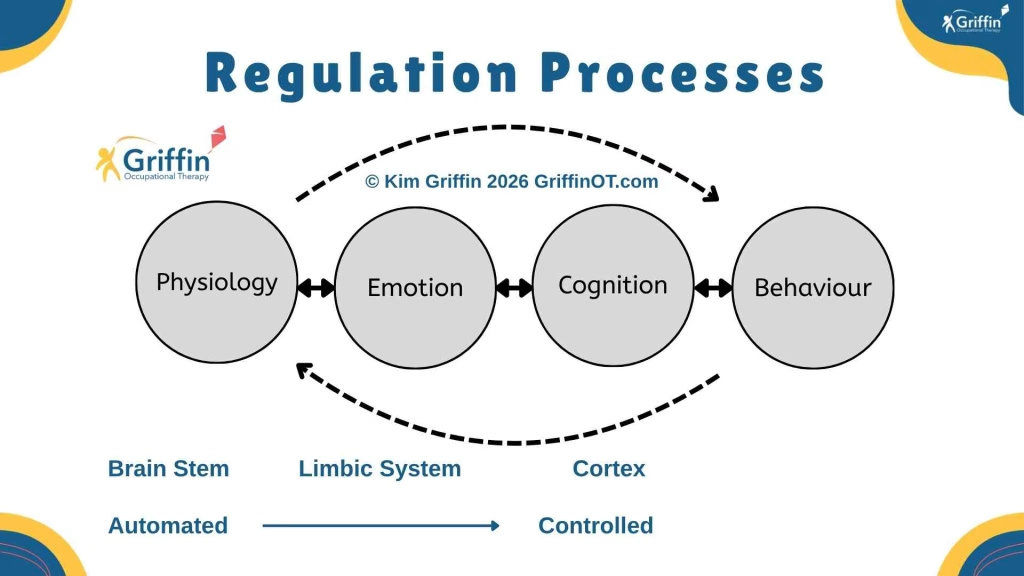
Strip away the different disciplines’ terminology, and most models of self-regulation are describing some combination of the same underlying domains: cognition, emotion, behaviour and physiology.
In education, the focus usually falls on cognition and emotion. A common definition used in education describes self-regulation as managing your thinking and feelings well enough to work towards a goal: staying organised, holding back an impulse, and finding constructive ways through a problem. This fits neatly with classroom life, managing your feelings and your thinking so you can get on with the task in front of you.
What’s less often talked about in education is physiology. Other definitions push further, describing self-regulation as managing your attention and your level of arousal, including the stress response happening in your body, all in the service of working towards a goal. In other words, underneath the cognitive and emotional pieces sits the nervous system, and its current level of arousal shapes what a child’s cognition and emotions can actually do in that moment. You cannot reason your way out of a state your body and nervous system is still highly aroused.
Additionally, these domains do not operate in isolation. Difficulty with attention and impulse control can lead to frustration; frustration, unmanaged, can tip into impulsive behaviour; and all of this happens against a backdrop of whatever the nervous system is currently doing. Thinking about self-regulation as one integrated system, rather than a set of separate skills, is a much more accurate, and much more useful, way to understand it.

Self-regulation develops from early childhood into adulthood
Self-regulation is not skill that a child achieves a at a certain age. It develops gradually, over decades, and continues developing well into adulthood (some research suggests up to the age of 32).
In infancy, regulation is almost entirely co-regulated and shaped heavily by biology and temperament. Through early and middle childhood, children gradually develop the building blocks: language, sensory processing and early executive function, alongside continued, heavy reliance on co-regulation from trusted adults. Adolescence brings its own shift. Teenagers become particularly sensitive to social reward and peer influence, and their executive function, especially impulse control, has not finished developing, even as expectations around independence increase. It is often not until adulthood that executive function reaches its peak, and by then, most of us have built up a lifetime of learned strategies to draw on, alongside the continued, quieter support of co-regulation from the people around us. These stages were eloquently described in a recently published review in Nature Human Behaviour.
This developmental arc matters for how we think about expectations at school. A five-year-old and a fifteen-year-old are at genuinely different points on this journey, and neither of them, nor most young adults, have finished developing this skill.
Why self-regulation isn’t always possible
As I covered in the first article in this series, the brain prioritises safety above everything else. When arousal rises, particularly into a state of threat, control shifts away from the thinking parts of the brain and towards the parts responsible for survival. This is not a choice a child, or an adult, is making. It is what the nervous system is built to do.
This means self-regulation is not a fixed skill someone either has or hasn’t got. It is state-dependent. The same child who can calmly talk through a disagreement at 10am might be entirely unable to do the same thing at 2.30pm, after a difficult lunchtime, on too little sleep, with a headache they haven’t mentioned. Triggers in the environment, a person’s history, and what’s going on internally for them right then, all affect how much capacity they have available in that moment.
It’s normal to dip in and out of regulation
Nobody is regulated all of the time. We are never always in the magical ‘green zone’, and expecting that of children, or of ourselves, sets an unrealistic standard. Dysregulation is not a sign that something has gone wrong. It is a normal, expected part of being human, and it happens, in smaller or larger ways, multiple times across most days and weeks.
This does not mean dysregulation should be ignored, or that patterns are not worth noticing. But there is a real difference between a child having a rough afternoon and a child who is struggling significantly more than we’d expect for their age or situation. Building self-regulation skills matters, and so does accepting, without judgement, that everyone moves in and out of regulated states, and that this is entirely normal.
Children with additional needs, including autism, often find self-regulation more difficult, as their nervous systems can be more sensitive and they may dysregulate more quickly than others. Their underlying language and social communication skills are also often less mature, so the development of their self-regulation skills is often delayed too. We need to account for this when expecting them to ‘self-regulate’, as they may not be developmentally ready, even if they are ‘old enough’ on paper.
Self-regulation is a complicated process that is learnt through experiences. It develops from birth through to adulthood and can be impacted by the environment we grow up in and how safe and secure our relationships are.
Building self-regulation: ideas for home and school
Given how gradual and effortful this developmental process is, it helps to think about what we can actively do, rather than simply waiting for a child’s self-regulation skills to be developed. Broadly, support falls into two categories: proactive strategies we put in place in advance, and reactive strategies we reach for in the moment. The ideas below are a starting point, and work best when tailored to what actually helps the individual child, rather than applied as a generic checklist. As I said in part two of this series – co-regulation is an essential first step towards developing self-regulation skills.
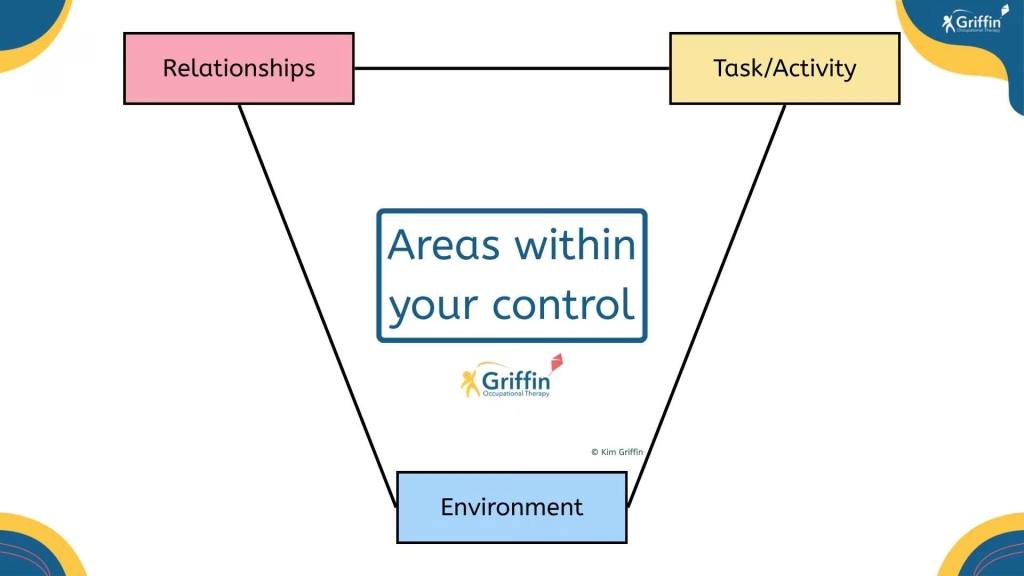
Environment, Relationships and Task
When putting in support strategies, environment set-up comes first. A calmer classroom set-up, fewer distractions, and thought given to sensory needs at lunch, playtime or in the hall, all reduce the everyday load on a child’s regulation. Proactive supports include predictable routines, visual schedules for transitions, and warnings before a change is coming. Building in regular downtime, and a quieter wind-down after busier activities, before a meltdown rather than after one, helps a child’s nervous system reset throughout the day. Some children find movement breaks can be helpful for regulation as well.
Adjusting the task matters too: matching work to a child’s sensory profile and learning needs, keeping it within reach rather than overwhelming, making it motivating, and starting from what a child can already do rather than where they’re struggling.
None of this works without consistency and safety in the relationship itself, so time spent building trust with a key adult, before it’s needed, is never wasted. We must be aware the impact we have on the child’s ability to regulate. Sometimes we are area the trigger and we need to be aware of how we can adjust ourselves in the moment or when a change of adult may be needed.
Identify supports when regulated
It also helps to build a toolkit of strategies with your child when they’re regulated, rather than introducing something new in the middle of a meltdown. This might include sensory strategies, like movement, deep pressure or fidget toys, alongside non-sensory options like drawing, a short walk, a drink of water or a familiar puzzle. In the moment, reducing demands, removing triggers where you can, and keeping your own language short and calm, matters more than which specific strategy you reach for. Practising those strategies when a child is regulated makes them far more likely to work in the moment.
Many schools also build self-regulation skills directly, through programmes like Zones of Regulation, RULER, PATHS, Tools of the Mind, or the Alert Program. These work best as ongoing teaching, not a one-off assembly, and alongside acceptance that dysregulation is a normal, expected part of the school day, not a behaviour problem to eliminate.
During dysregulation
When dysregulation does happen, removing the trigger, reducing demands, adapting the environment or task, and cutting back on language, are usually more effective than talking a child through what they’ve done wrong. It can sometimes be more successful if you model the behaviour you want to see. For example, if you breath slowly, this could be a better prompt for the child to breathe slowly than telling them to breathe. Or you could point the child towards one of their pre-determined supports, by using a visual or by physically bringing to them. Sometimes they may just need some space, but it’s important that you’re on standby for when they are ready to re-engage.
Quick fire questions: Self-regulation
Is self-regulation the same thing as behaviour management?
Not quite. Behaviour management usually focuses on the behaviour itself, whereas self-regulation is about the underlying capacity to manage cognition, emotion and physiology that produces the behaviour. A child can look ‘well-behaved’ and still be highly dysregulated internally, particularly if they tend to freeze or shut down rather than act out.
Why can my child self-regulate at school but not at home?
This is common, and it sometimes reflects how much effort a child is putting into holding it together during the school day. Some children spend so much energy managing themselves in a structured environment that they have little capacity left by the time they get home, where they finally feel safe enough to let that go. In some cases, the set-up and structure of the school environment is what facilitates regulation and the lack of structure at home is less supportive. In other cases, there are routines and habits that have been developed at home since early infancy, which the child continues when they arrive at home. Teachers can set different rules and create new routines and habits as they get to start from scratch each academic year, and most children learn which behaviours are acceptable in which environments and with which adults.
At what age should a child be able to self-regulate independently?
There isn’t a single age where this switches on. Self-regulation develops gradually across childhood and adolescence, and even into adulthood, and it depends on the situation, the child’s individual development, and how dysregulated they currently are. Expecting full, independent self-regulation from a young child, or from any child in a highly stressed state, isn’t realistic. Even as adults, we don’t get it right all the time, so it’s unrealistic to expect this of our children. Children and adolescents with additional needs usually need longer to develop self-regulation skills than their same aged peers.
Final thoughts
Self-regulation is a genuinely complicated, multi-domain skill, encompassing cognition, emotion, behaviour and physiology, and it takes decades to develop. Education tends to focus on the cognitive and emotional pieces, but the physiological piece underneath shapes what’s available to a child in any given moment. Higher arousal states make self-regulation harder, sometimes impossible, and dipping in and out of dysregulation across a day or a week is entirely normal, for children and adults alike. Understanding this does not lower our expectations. It makes them realistic, and it helps us know when a child needs co-regulation, when they’re ready to manage more independently themselves, and which every day, practical supports they need to stay engaged throughout the day.
About the author
All articles on the GriffinOT website are written by children’s occupational therapist Kim Griffin. Kim has over 25 years’ experience supporting children with sensory and skill needs, their teachers and families. She is the author of multiple books, presents all training at GriffinOT and hosts the EBPOT podcast. Kim is currently completing her PhD, focussing on supporting children’s self-regulation in schools, at Oxford Brookes University. You can view Kim’s academic publications on her ORCID profile, or Google Scholar page.
Date last updated by Kim: 31st August 2026
Other Articles You Might Be Interested In