Let’s explore regulation
Regulation is a term that is used frequently in schools and by therapists. Most frequently it’s linked to being able to self-regulate. Before I started my PhD, I thought I had a pretty good idea what it was. However, I was in for a quite a surprise when I started my background reading! It turns out that there are many different opinions on how regulation and self-regulation are defined. So, I want to share my learnings with you.
This article is the introduction to a three-part series that will cover regulation, co-regulation and self-regulation. In this article I will

Let’s explore regulation
Regulation is a term that is used frequently in schools and by therapists. Most frequently it’s linked to being able to self-regulate. Before I started my PhD, I thought I had a pretty good idea what it was. However, I was in for a quite a surprise when I started my background reading! It turns out that there are many different opinions on how regulation and self-regulation are defined. So, I want to share my learnings with you.
This article is the introduction to a three-part series that will cover regulation, co-regulation and self-regulation. In this article I will

What is Regulation?
I think the definition I like the best comes from Nigg. He describes regulation as the ongoing, dynamic, and adaptive modulation of internal state (emotions and cognition) or behaviour which is driven by physiology. That might sound like a mouthful at first, but let’s break the terms down.
- Ongoing – means that it’s occurring all the time
- Dynamic – means its changing
- Adaptive – means that it adjusts, or adapts
- Modulation – is the ability to tune or modify
- Internal state – refers to your own feelings, thinking and arousal level (I describe arousal in more detail here)
- Physiology – the nervous system’s response to stress (more below)
Therefore, regulation refers the continual changes, adjustments and modifications the nervous makes throughout the day to help the body to stay safe and organised.
Arousal
Before going any further, it’s helpful that you also understand the term arousal. Arousal is the level of alertness in the body and can range from low, or asleep, to high, or highly stressed (see this article if you need more information).
Different activities require different levels of arousal. Sometimes, the body is not safe, and the nervous system must increase arousal to protect it. For example, if you see a cyclist speeding towards you, you might need to jump out of the way quickly. To do this, the nervous system will increase the level of arousal to match the situation, and you might feel stressed. Once safe, the nervous system should decrease our level of arousal. However, some people find this ramping up and calming down – or regulating – more difficult than others.
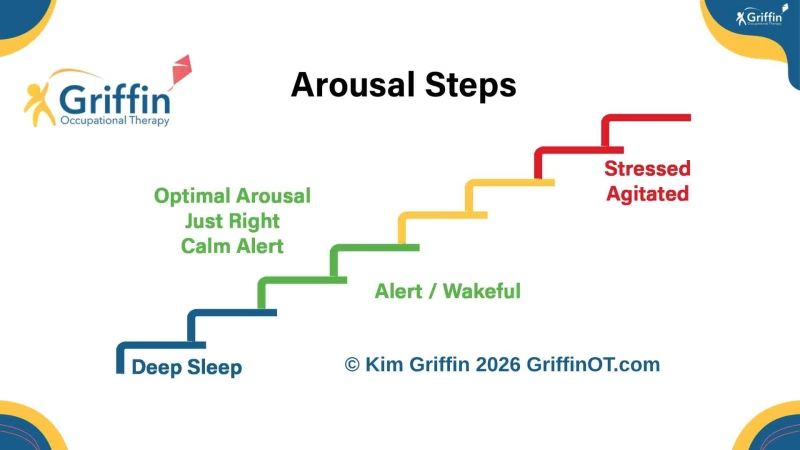
Please note if you are using this image in any of your work (e.g. presentations, handouts) the correct citation is: Griffin, K. (2026). Arousal, Attention and Sensory Processing What’s the Links? GriffinOT. https://www.griffinot.com/arousal-attention-sensory-processing-adhd-autism/. This citation, including an active link must appear in your work both on the image page and in the reference list.
Regulation
Regulation is essentially the ability to adjust arousal to match the environment, relationship and/or task. Throughout the day the brain and body are constantly doing things to increase and decrease arousal levels in an effort stay regulated. Some of the actions are automated, like increasing heart rate if we start to run. Other are deliberate, like choosing to walk away from a situation before an argument develops.
Some children (and adults) have more difficulty regulating themselves than others. This could include difficulty with sensory regulation and/or emotional regulation. Difficulty with regulation is often reported in autism, ADHD and attachment disorders.
Dysregulated
Dysregulated is the opposite of regulated. So, it is when an individual’s arousal state does not match the environment, relationship and/or task. It could be too high, and they might be too stressed. Or it could be too low, and they could be too tired. Often, we think of dysregulation as angry, out of control or impulsive behaviour. However, it’s important to remember an individual may freeze or dissociate as well. So, externally they look ‘fine’ but internally they might actually be highly stressed.
How does regulation develop?
The ability to regulate starts to develop when we are a baby. Long before we can self-regulate, we need help from our caregivers. When babies start to show distress, their caregivers swaddle, carry, rock and feed them. Caregivers should provide what is required to help the baby to organise their arousal. As these needs are met the infant learns patterns and rhythms. They learn that when they hear mum or dad’s footsteps, help is on the way.
Regulation develops over time and with experience. Each time a child experiences dysregulation and can regulate, they strengthen their ability to do this, and they get to know what strategies help them. This process starts with co-regulation.

Co-regulation
Co-regulation is when someone else helps another individual to regulate. We usually think of adults helping children. However, adults help adults all the time. Think about when a friend or family member was upset and you gave them a hug. Or a time when they were angry and you listened. One unique feature of mammals is that we frequently co-regulate. You will see a mother cat co-regulate its kitten through licking, but you would never observe reptiles such as snakes or crocodiles doing this with their babies!
Toddlers need huge amounts of support from their caregivers to regulate and self-soothe. Whilst they are starting to be a bit more independent, the regulation centres of their brain are still developing. Sarah Ockwell Smith suggests that it isn’t until after a child’s fifth birthday that their brain is developmentally mature enough for them to start to self-soothe or self-regulate. Parents of teenagers would also argue that hormones severely disrupt this skill.
Regulation with the help of caregivers is what teaches children to self-regulate as they get older. They learn what they experience. Co-regulation helps them to develop the brain networks and strategies they need to self-regulate.
I explore co-regulation in more depth in the second article of this series: Co-regulation: A very powerful tool.
Self-regulation
Self-regulation is the ability to stay regulated without the help of others. It is the ability to use your own strategies to either calm down or energise. Some individuals need more help to learn how to self-regulate than others. Often individuals with ADHD and ASD need more support to learn to self-regulate. Sensory regulation strategies can help with self-regulation. As can cognitive strategies. I explore these here in this article.
Let’s explore regulation physiology
I mentioned above that some regulation automated, and some is deliberate or controlled. This is because they are organised in different parts of the brain. I will briefly describe them here, but I cover them in much more depth in Level 2 of my Success with Sensory training.
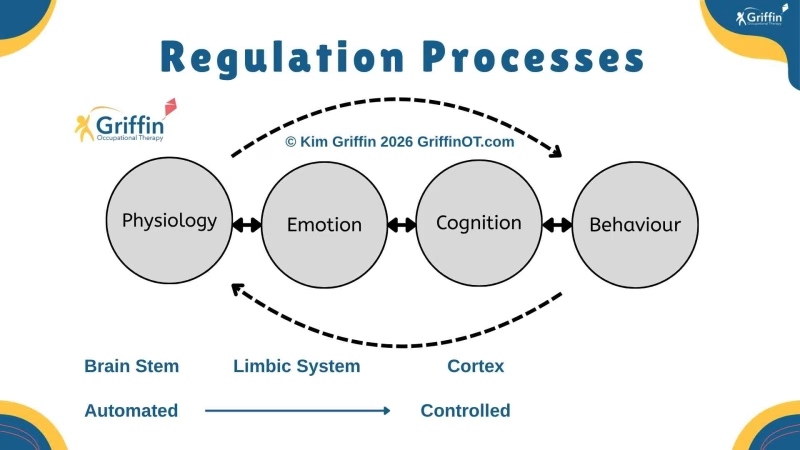
Please note if you are using this image in any of your work (e.g. presentations, handouts) the correct citation is: Griffin, K. (2026). Regulation Explained by an OT. GriffinOT. https://www.griffinot.com/regulation-explained-by-an-ot/. This citation, including an active link must appear in your work both on the image page and in the reference list.
Automatic regulation
Automatic regulation occurs in the parts of the brain that are responsible for survival. There are two areas. The brain stem, which is at the bottom of the brain, ensures that we stay alive. It is responsible for basic body functions like breathing, heart rate, hunger, sleep etc. These physiological activities happen in the background without us having to think about them.
The limbic system, which is roughly in the middle, focuses on safety. If we think about the bike example at the start of the article. When you are in this situation, you have likely jumped out of the way before you have even realised what happened. This is because the limbic system sensed danger and automatically acted. The limbic system process emotional as well.
Whilst we do have some control over these areas of the brain, it is limited. For example, when we feel the urge to go to the toilet, we can suppress it for long enough to find a toilet. However, if we keep ignoring it, the brain stem will eventually take over regardless of whether we found the toilet.
Controlled regulation
Controlled or conscious regulation is a cognitive process which occurs in the cortex. This is the top layer of the brain that allows us to think, plan and organise our actions. When we are regulated, the cortex is usually in control. Going back to the bike example, the cortex might check the road at the start to make sure you’re walking in the pedestrian lane, and not the bike lane. The cortex supports children to put their hand up before calling out in class. It is the area that allows children to access learning.
As mentioned above, the cortex does have some control over automate brain responses. But it is limited. And the more dysregulated we are, the less control our cortex has. This is because once we become dysregulated, the limbic system and brain stem are in charge. When this happens, it’s hard for us to understand language and to make sensible decisions. It’s the moment we might say or do something that we regret later. This is because our body’s primary focus in that moment is safety. And it is why regulation is really difficult sometimes and we end up fighting, shutting down or running away. These are subconscious, automated responses designed to keep us safe.
Dr Dan Siegle explains this using the ‘hand model’ of the brain. You can watch him explain this in the video below.
Regulation is a complex process. Some of it is controlled, but some of it is automated. When supporting children i’s useful to think about which arousal state they are currently in as this will let you choose the best support approach.
Supporting regulation
Supporting self-regulation starts with relationships, safety and co-regulation. Children first need consistent co-regulation experiences before they can internalise those strategies and use them independently. When a trusted adult stays calm, meets a child’s needs and helps them to co-regulate, the child slowly develops the neural pathways they need to manage this themselves. This development comes through multiple experiences of co-regulation and modelling by adults.
Prioritise safety and co-regulation
Secondly, it is essential to remember that the brain will always prioritise safety. If the child (or adult) is not feeling safe, their brain stem and limbic system will take over. In these moments, we can’t process language very well, as our cortex is offline. Our response will be more chaotic, and the limbic system is ready to fight, flight or freeze. Supporting anyone at this stage of dysregulation should start by removing the trigger and making the environment safe. Short phrasing (e.g. single words) and modelling of body-based techniques (such as breathing or a hug) can be helpful. Do what you want the person to do, rather than tell them. That is, breathe slowly and obviously, rather than say ‘take a breath’. The image below shows you which areas of the brain control which areas of the brain control each different part.
Teach skills when regulated
Finally, when the child is regulated, it is helpful to teach children about arousal and to build their own toolkit of strategies that work for them. This looks different for every child. For some, movement breaks like a short walk or some jumping jacks can shift their arousal level enough to re-engage with learning. For others, a quiet space with reduced sensory input gives their nervous system the chance to reset. Reading, colouring, matching games, and bouncing on a yoga ball are all things I have seen work for individual children.
Sensory strategies
Sensory strategies, such as those covered in GriffinOT’s Success with Sensory Strategies training, can be a powerful part of a child’s self-regulation toolkit. But they work best when they are chosen carefully based on the child’s individual profile. They also should be practised at times of regulation, so the child knows how to use them when they are dysregulated.
Quick fire questions: Regulation
Why does my child hit out when they are upset?
When a child hits out, it’s often because in that moment, the brain’s priority is safety, not social behaviour. Their response is subconscious and automatic. Initially it’s not a choice. In saying that, in my experience over time it can become a habitual behaviour. This is why it’s important to help the child to identify more appropriate regulation strategies early on. It is important to be clear that hitting is never ok, and to direct the child to more appropriate options. For example, ‘No hitting mummy, I can see you are upset/frustrated, can I give you a hug’. Or, if the child is seeking the proprioceptive feedback which comes with the impact, it might be more helpful to re-direct them to hitting a yoga ball or jumping on a trampoline. The strategy will depend on the child, but it is important to make it very clear early on (even with very young children) that hitting is not ok and to find a suitable redirection.
Why does my student sometimes hide under the desk?
Hiding under the desk is usually a freeze or shutdown response. It’s usually a sign of overload or overwhelm. This overload can come from sensations or sometimes it can be due to the task or interaction. The child’s brain is feeling unsafe and is trying to regulate, internally they’re likely highly stressed. It’s important to remember the child will not be able to process language very well at this time. In my experience, it’s important to reduce demands, stay calm and give the child’s nervous system time to settle before gently re-engaging.
Why can some children calm down quickly whilst others seem to stay upset for a long time?
The ability to regulate develops gradually and varies enormously between children. Some nervous systems are naturally more heightened and naturally become dysregulated more quickly than others. Equally some of us move through arousal states more fluidly, whilst others find it genuinely harder to shift out of a heightened state.
Children with ADHD, autism, or early attachment difficulties often need more support, as neurologically their brains are often wired to be more alert. Sometimes they have poor interoceptive awareness, so they don’t notice when they are starting to dysregulate. So, by the time they realise, their limbic system is already in control. Additionally, they may have had less co-regulation opportunities. In the case of autism, they may not have been paying as much attention to the social cues of adults trying to co-regulate them. If there are attachment needs, the child has had fewer experiences of co-regulation with a trusted adult. This means their nervous system has less experience of being regulated and, unfortunately, dysregulation is a more normal feeling, so being regulated can feel unsafe. These children need co-regulation first before they should be expected to self-regulate.
Final thoughts
Regulation is not a skill children either have or don’t have — it develops gradually, from childhood to adulthood. Understanding the difference between automatic and controlled regulation is important, as it helps us to respond to children with the right strategies at the right time. It also helps us to know when we might need to use strategies ourselves to regulate first before supporting our children. Finally, it explains why sometimes responses seem non-sensical, anti-social and unsafe. The brain will always prioritise survival. Just knowing that will help you to adjust your own response and co-regulate with compassion and understanding.
About the author
All articles on the GriffinOT website are written by children’s occupational therapist Kim Griffin. Kim has over 25 years’ experience supporting children with sensory and skill needs, their teachers and families. She is the author of multiple books, presents all training at GriffinOT and hosts the EBPOT podcast. Kim is currently completing her PhD, focussing on supporting children’s self-regulation in schools, at Oxford Brookes University. You can view Kim’s academic publications on her ORCID profile, or Google Scholar page.
Date last updated by Kim: 31st August 2026
Other Articles You Might Be Interested In