Let’s explore co-regulation
Think about the last time a child in your class, or your own child, was really struggling. Maybe they cried, shouted, hit out or shut down completely. Sometimes, without quite realising it, we expect them to reach for a strategy and calm themselves down. But in that moment, a child rarely has access to the part of the brain that lets them do this. What they need instead is a much more powerful tool: co-regulation.
This is the second article in a three-part series on regulation. In the first, I explained what regulation is and how the brain manages it. Here, I want to focus on co-regulation: the support we give another person to help them regulate. Co-regulation is not just something we do with babies and toddlers. It is a powerful, ongoing tool that adults can use at every age and stage.
In this article, I’ll cover

Let’s explore co-regulation
Think about the last time a child in your class, or your own child, was really struggling. Maybe they cried, shouted, hit out or shut down completely. Sometimes, without quite realising it, we expect them to reach for a strategy and calm themselves down. But in that moment, a child rarely has access to the part of the brain that lets them do this. What they need instead is a much more powerful tool: co-regulation.
This is the second article in a three-part series on regulation. In the first, I explained what regulation is and how the brain manages it. Here, I want to focus on co-regulation: the support we give another person to help them regulate. Co-regulation is not just something we do with babies and toddlers. It is a powerful, ongoing tool that adults can use at every age and stage.
In this article, I’ll cover
Why co-regulation comes first
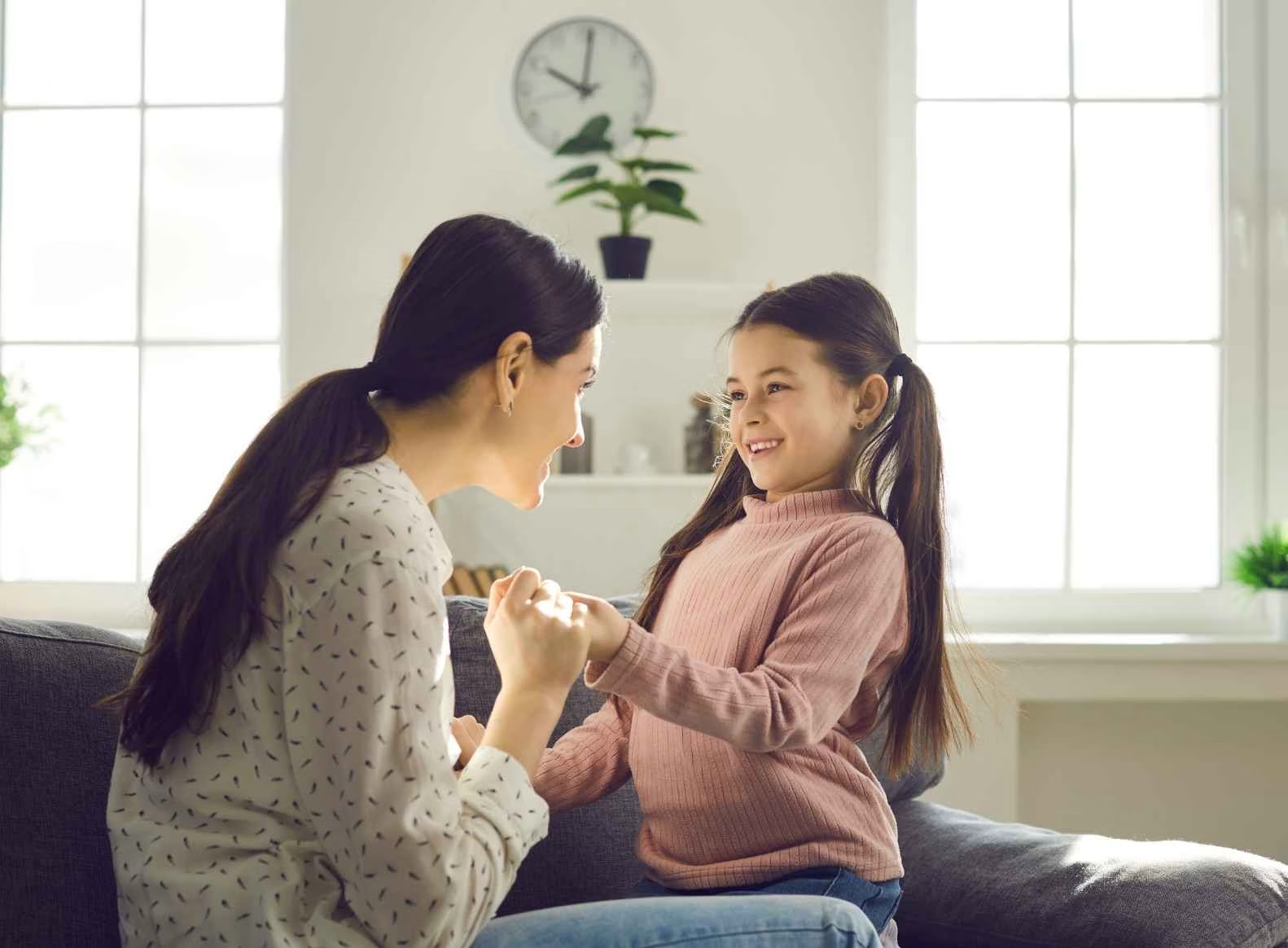
Self-regulation does not appear out of nowhere. Children learn to regulate their own arousal because someone else regulated it for them, over and over again, until their brain built the pathways to do it independently. Every time a caregiver notices a child’s distress and responds, with a calm voice, a cuddle, a change of environment, the child’s nervous system gets a lived experience that dysregulation happens, and then it passes. Repeated enough times, this becomes an internal expectation, and eventually, an internal skill.
This is why co-regulation in infancy and early childhood matters so much. It is not a stepping stone we rush through on the way to the ‘real’ skill of self-regulation. It is the mechanism that builds self-regulation. Without enough co-regulation, a child’s brain simply does not get the practice it needs, and self-regulation develops more slowly, or less robustly.
The infant-parent bond: the foundation of regulation
Long before a baby can do anything for themselves, their regulation depends entirely on their caregiver. When a baby cries and a parent responds, feeding, rocking, swaddling, or simply picking them up, the baby’s arousal comes back down. Over time, the baby starts to anticipate this. They learn that footsteps on the stairs, or a familiar voice, mean help is coming.
This is about safety as much as comfort. A responsive, attuned relationship tells a baby’s nervous system that the world is safe and that their needs will be met. This is the foundation later regulation is built on. Children who experience consistent, sensitive caregiving in infancy tend to develop stronger self-regulation skills later, because their nervous system has learned, from the very beginning, what safety and a regulated nervous system actually feel like.
This does not mean every cry needs an instant response, or that parents need to get it right every time. It means that, overall, the relationship is one where a child’s distress is noticed and responded to. This is what builds a secure base a child can return to, again and again, as they grow. It helps them to associate the feeling of safety with a regulated nervous system.

Co-regulation doesn’t stop in early childhood
It’s tempting to think of co-regulation as something children grow out of, a scaffold we can remove once self-regulation is established. But this is not how it works, for children or for adults. Think about the last time you were really upset. Did you want to be left entirely alone to sort it out, or did having someone calm nearby, even just sitting with you, help? Even as adults we often like to be able to talk things through, or to have a hug, or just to know that someone else is there if we want to reach out.
The need for co-regulation continues right through childhood, adolescence and into adulthood. What changes is how much of it we need, and when. Older children and adults can usually self-regulate through everyday, lower-level stress. But at higher states of dysregulation, when the thinking part of the brain has less influence, most of us need co-regulation again, whatever our age.
This matters because it’s easy to expect too much of older children, particularly at school. A teenager who is falling apart has not suddenly lost a skill they had yesterday. Their nervous system has just moved into a state where self-regulation is not accessible to them right now, and they need co-regulation just as much as a much younger child would. I explore how the nervous system impacts different arousal states in more detail in the first part of this series.

Rough and tumble play: practising arousal safely
Co-regulation is not only about calming a child down. It is also about giving them safe opportunities to ramp their arousal up, and then come back down again, with a trusted adult, sibling or peer alongside them. This is where rough and tumble play comes in.
Chasing, wrestling, peek-a-boo, being swung round or thrown gently in the air: this kind of play deliberately raises a child’s arousal and heart rate. Done with a trusted adult, or within any relationship the child feels safe in, it gives them practice at tolerating higher states of arousal without becoming overwhelmed. All mammals engage in this type of play. I’m sure you can remember seeing a puppy or kitten nip or paw at its parents or siblings, in a playful way. They learn what it feels like when their body ramps up, and, because the adult is right there, they learn that it is safe, and that they can come back down again.
This kind of play also lets children test boundaries in a low-stakes way. How far can I push this game? What happens if I say stop? Can I trust this adult to listen? These are all questions a child works through as they play, and the answers help them build a working model of relationships and regulation that they carry with them elsewhere.
Using co-regulation as a tool at home and school
Co-regulation is a powerful tool adults can use deliberately to support children at school and home. It should not be something that only happens by accident. Co-regulation can be used proactively throughout the day, in two ways. Firstly, we can make changes in advance. Secondly, we can give support and make adjustments in the moment.
In advance: adjusting the environment, task and activity
Much of co-regulation happens before a child ever becomes dysregulated, through the choices we make about their environment, task and activity. A calmer classroom, a quieter corner, a visual timetable, a task broken into smaller steps, built-in movement breaks: all of these are ways adults use co-regulation proactively. We are not waiting for the child to self-regulate their way through an environment or task that is setting them up to struggle. We are adjusting things so that regulation is more achievable in the first place.
This is the same principle I’ve written about elsewhere in relation to sensory strategies: the environment, task and relationship need to be right first, and any additional strategy sits on top of that foundation, not instead of it. I cover these principles in a lot more depth in the full Success with Sensory training, and there’s also a short course on self-regulation in the GriffinOT membership.
In the moment: co-regulating through dysregulation
When a child does become dysregulated, co-regulation looks like staying close, staying calm, and reducing what we are asking of them. This might mean crouching down, lowering your voice, using fewer words, or simply being present without demanding anything. It might mean modelling the breathing you want to see, rather than instructing it. Do what you want the child to do, rather than telling them to do it. This is sometimes an easier way to get them to engage. Imagine the last time you were frustrated. Did someone telling you to ‘take a breath’ actually help? Or did it make you more annoyed?
Some children (and adults) may need space; however, this does not mean that we should completely withdraw. It is important to make sure that the child is in a safe environment. We can also stay close and available, without any specific agenda.
None of this means rescuing a child from every difficult feeling, or removing every challenge. It means recognising when a child genuinely cannot access self-regulation in that moment, and offering the support that lets their nervous system come back down, so that learning, problem-solving or repair can happen afterwards.
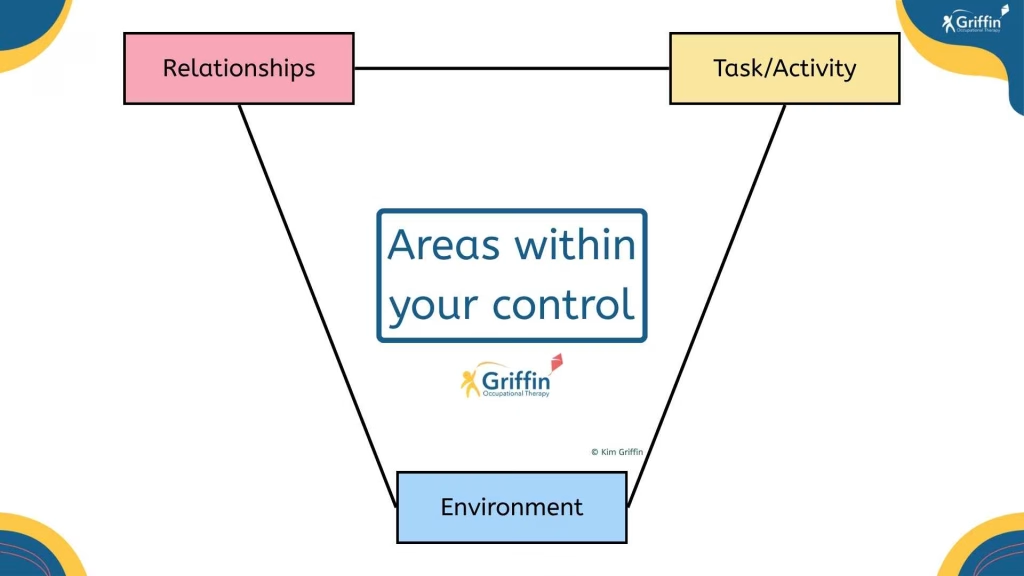
Co-regulation is a powerful tool. We can proactively use the environment set-up, the activities we a presenting and our relationships with our children to facilitate their regulation.
Quick fire questions: Co-regulation
Doesn’t co-regulating a child stop them learning to cope on their own?
No. The evidence points the other way. Children build self-regulation through repeated experiences of co-regulation, not despite them. A child who consistently receives co-regulation when they need it is more likely to develop strong self-regulation, not less, because their brain has had the practice it needs.
My teenager pushes me away when they’re upset. How can I still co-regulate them?
Co-regulation does not have to mean physical closeness or conversation. For an older child or teenager, it might mean staying calmly present in the next room, sending a short, low-demand message, or simply not escalating things yourself. The goal is a calm, steady presence they can draw on, even if they can’t accept it directly in the moment. The worst thing you can do is ask ‘why’. Usually, we don’t have access to the thinking part of our brain when we’re highly dysregulated, and it’s really hard to explain why. That’s a question for another day.
How do I know if a child needs co-regulation, or if they can self-regulate independently?
Watch their level of dysregulation rather than their age. A child who is mildly frustrated might well have the resources to self-regulate. A child who is highly distressed, shut down, or in fight, flight or freeze, needs co-regulation first, whatever their age, before self-regulation becomes possible again.
Final thoughts
Co-regulation is not a phase we move through on the way to self-regulation. It is the ongoing relationship that makes self-regulation possible in the first place, from a baby settled by a familiar voice, to a teenager who needs someone to simply sit with them, to an adult who feels better after a difficult conversation with a friend. As adults, we can use co-regulation deliberately: adjusting environments, tasks and activities in advance, and offering calm, steady support in the moment. The next article in this series looks more closely at self-regulation itself, and why it’s such a complicated term.
About the author
All articles on the GriffinOT website are written by children’s occupational therapist Kim Griffin. Kim has over 25 years’ experience supporting children with sensory and skill needs, their teachers and families. She is the author of multiple books, presents all training at GriffinOT and hosts the EBPOT podcast. Kim is currently completing her PhD, focussing on supporting children’s self-regulation in schools, at Oxford Brookes University. You can view Kim’s academic publications on her ORCID profile, or Google Scholar page.
Date last updated by Kim: 31st August 2026
Other Articles You Might Be Interested In