
Sensory circuits are not a magic bullet for schools
Sensory circuits are often sold as a fix all for all sensory and self-regulation needs. The premise of a sensory circuit is outlined in a book by Jan Horwood. As an OT, Jan was looking to manualise the use of sensory strategies into an easy format that schools could implement. The sensory circuit was an answer, and the book outlines a three-step plan for all sensory circuits. The challenge is, this simplification misses many of the nuances of sensory processing issues and this post will explain three reasons why. I will discuss

Sensory circuits are not a magic bullet for schools
Sensory circuits are often sold as a fix all for all sensory and self-regulation needs. The premise of a sensory circuit is outlined in a book by Jan Horwood. As an OT, Jan was looking to manualise the use of sensory strategies into an easy format that schools could implement. The sensory circuit was an answer, and the book outlines a three-step plan for all sensory circuits. The challenge is, this simplification misses many of the nuances of sensory processing issues and this post will explain three reasons why. I will discuss

Problems with the one and done sensory circuit
The reality is that the sensory needs of children and adults are present throughout the day. Completing a sensory circuit at 9 am in the morning, might be helpful for the child’s first lesson. However, it is unlikely that it will be helping by 11am. For most children (and adults), a single intervention at the start of the day simply cannot meet their ongoing, ever-changing regulation needs across an entire day. A sensory circuit is only one part of a what needs to be a much larger solution for them.
Additionally in schools, sensory circuits are typically scheduled around staff or room availability, rather than when the child might need to do them. To have maximum impact, sensory supports need to be available throughout the day. They should also be aligned to when the child needs them, this might be at specific times. It could also be before or after specific subject or situations. Ideally the child will have access to a selection of options that are integrated through the day, and options they can access when needed.
The three station sensory circuit sequence isn’t what every child needs
The three-station sensory circuit is actually a simplification of a very complex phenomenon. It’s a great way to present a clear formula that can be implemented in schools, but it completely ignores the fact that sensory modulation is an incredibly complicated process. The reality is that all children (and adults) experience sensations differently and have individual sensory needs and preferences. This means that children need access to different things.
A child whose sensory system is very under-responsive, may actually need three alerting activities, rather than the one alerting, one organising and one calming sequence as presented in the book. Another child might need three calming activities. And without completing sensory needs checklist for the child, you simply won’t know what they need. To have real impact, you have to start with a thorough assessment, not an off the shelf solution. This is something I cover in depth in my sensory training. In part two I take learners through these different profiles and provide practical checklists to help you identify what each child actually needs.

Impactful sensory circuits require good assessment of the child’s needs and careful planning. In addition, the only work if the environment, task and relathions are also meeting the child’s needs. If this is not the case, they are nothing more than a sticking plaster or bandaid.
A sensory circuit does not mitigate an overloading environment
The final issue I see with many sensory circuits, is that even if the child is regulated after completing it, they are then put back into a totally dysregulating environment. So, they are immediately dysregulated again. Sensory circuits are seen as the solution – but in fact environment, task and relationship adaptations would be much more powerful.
The child (or adult) does not operate in a vacuum, especially at school. For some, the sensory circuit is a nice break with a trusted staff member, and it might help for that moment. But then they are thrust back into a classroom where the noise is overwhelming, the lights flicker, and the task is too hard. They are still overloading because their triggers are still there and their other needs are not being met. For me, this is actually the starting point. A sensory circuit cannot compensate for an environment or task that is not meeting the child’s needs. Real change starts with understanding the whole picture and putting those supports in place first. A properly designed sensory circuit can be an addition, but it will never be a magic silver bullet.
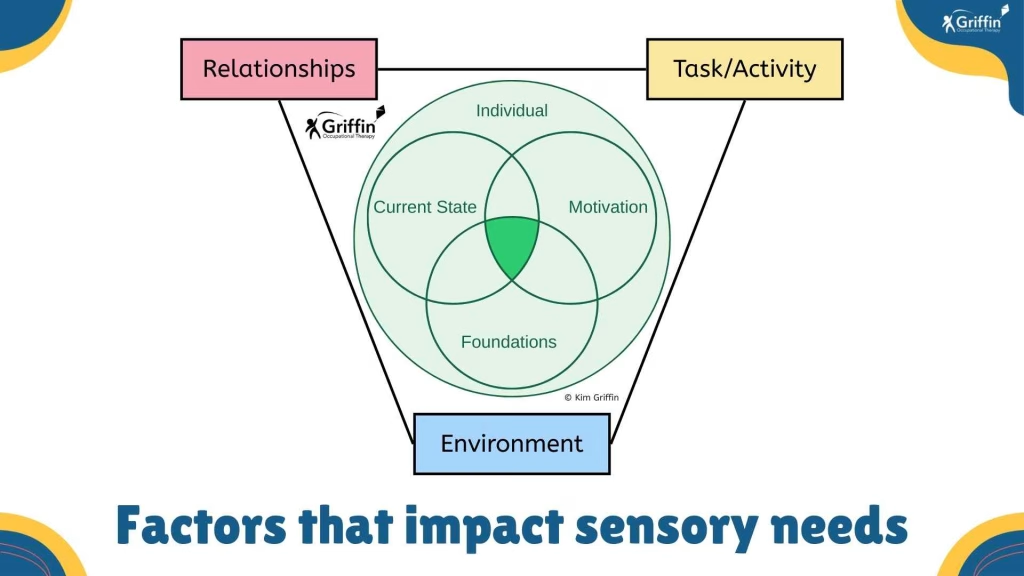
Understanding sensory needs and good planning is key for success
It is great that the sensory circuit book has increased school’s awareness of sensory needs and provided them with some information. However, sensory needs are just much more complicated and for some children the simplification may not be meeting their true needs. At best they may have a nice time with staff. However if the sensory circuit contains the wrong types of activities, it could actually increase their dysregulation rather than improve it.
If you really want to understand sensory needs and have clear guidance on designing and monitoring the outcomes of sensory circuits the following resources will be helpful for you
- Success with Sensory Strategies (training) – GriffinOT’s three-part online training, which includes sensory need checklists, environment audits, explanations of sensory needs and a short course on sensory circuits
- Success with Sensory Supports (book) – Kim’s second sensory book which explains the nuances of sensory needs and helps you to choose the right strategies for the right children.
- Sensory circuits a brief introduction (blog post) – a quick introduction but it is still highly recommended you do the training!
About the author
All articles on the GriffinOT website are written by children’s occupational therapist Kim Griffin. Kim has over 25 years’ experience supporting children with sensory and skill needs, their teachers and families. She is the author of multiple books, presents all training at GriffinOT and hosts the EBPOT podcast. Kim is currently completing her PhD, focussing on supporting children’s self-regulation in schools, at Oxford Brookes University. You can view Kim’s academic publications on her ORCID profile, or Google Scholar page.
Date last updated by Kim: 8th October 2026
Other Articles You Might Be Interested In