
Sensory Processing CPD for Occupational Therapists
Sensory Strategies for OTs from Evidence to Practice is a series of bite sized training designed for paediatric occupational therapists who want to learn more about using sensory based interventions at home and school. This 8-10 hour training is designed specifically for paediatric occupational therapists who want to use sensory strategies safely and effectively in real-world settings. The sensory series for OTs aims to demystify the world of sensory supports and give occupational therapists practical tips they can use immediately with the schools, children and families on their caseloads. There’s no gimmicks or made-up certifications – just real world solutions from an experience OT who is still working on the ground.
The training is delivered live January-February each year. It is then available as a self-paced pre-recorded course for the rest of the year.

Sensory Processing CPD for Occupational Therapists
Sensory Strategies for OTs from Evidence to Practice is a series of bite sized training designed for paediatric occupational therapists who want to learn more about using sensory based interventions at home and school. This 8-10 hour training is designed specifically for paediatric occupational therapists who want to use sensory strategies safely and effectively in real-world settings. The sensory series for OTs aims to demystify the world of sensory supports and give occupational therapists practical tips they can use immediately with the schools, children and families on their caseloads. There’s no gimmicks or made-up certifications – just real world solutions from an experience OT who is still working on the ground.
The training is delivered live January-February each year. It is then available as a self-paced pre-recorded course for the rest of the year.

Sensory Supports/Strategies for OTs at Home and School
The Sensory Strategies for OTs from Evidence to Practice explores practical application of sensory-based interventions or sensory strategies. This includes things like sensory circuits, fidget toys, wobble cushions, heavy work, chew toys – all of the items we recommend to schools and families to support regulation. It is written and delivered by paediatric OT Kim Griffin. Kim has over twenty years experience supporting children, their teachers and families. Her interest areas include sensory processing, autism and play. You can read more about Kim here.
Kim’s sensory strategies for OTs series aims to make you feel confident in using sensory-based solutions at home and school. Over five workshops, Kim explores the world of sensory processing. She explains the history of sensory integration theory and sensory processing and where Dunn’s model fits into this. She will help you to understand the current evidence which is available to support the use of sensory supports (spoiler – there isn’t a lot unfortunately). The series then helps you to know which assessment tools you can use to identify children and adult’s sensory needs (both standardised and non-standardised. Then in the final two workshops Kim discusses how to practically implement sensory regulation solutions in schools and at home.
Pre-recorded training
The series is currently available to purchase a pre-recording training and live Q&A session. The recordings are all from the live training and are delivered by Kim. You will have six months’ access to the content and can attend Q&A sessions during you paid access. The 2026 Q&A sessions are scheduled for 23 Feb evening, 15 May lunch time, 14 September evening, 13 November lunch time and can be booked using the link in the training. The Q&A sessions are NOT recorded.
Live training
The live online sensory workshops run for 90 minutes across 6 weeks. It will run again in early 2027 (probably Jan-Feb). Bookings will open in October 2026.
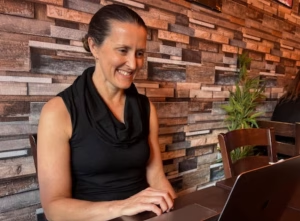

Who is this Sensory Sensory Strategies for OTs written for?
Sensory Strategies for OTs – Evidence to Practice is specifically written for paediatric and school-based occupational therapists who:
- Work with children in schools, homes, or community settings
- Want to move beyond sensory diets and fidget toys to evidence-informed practice
- Need practical strategies they can teach to teachers, teaching assistants, and parents
- Want to understand the history and theoretical models underpinning sensory strategies
- Are committed to honest, evidence-informed clinical reasoning with a focus on participation
- Prefer learning from a real school-based OT, not AI-generated or computer voiced content
Why choose Sensory Strategies for OTs – Evidence to Practice?
Written by an OT for OTs
Whether you’re and OT exploring sensory inclusion training, sensory facilitation approaches, or evidence-based sensory interventions, this course will equip you with the critical thinking skills to navigate the complex landscape of sensory-based practice. You’ll learn how to assess sensory and arousal needs, write functional goals, and implement evidence-informed strategies that actually work in schools and homes – not just in clinic rooms.
This is NOT Ayres Sensory Integration (ASI) certification – the focus is sensory based interventions/sensory strategies
This training focuses on sensory-based strategies and supporting sensory modulation/sensory reactivity. It will provide sensory regulation strategies that school-based and community OTs can realistically use in practice. Kim will help you understand the differences between direct sensory integration therapy and sensory supports, and we’ll be honest about what the evidence does (and doesn’t) support. You’ll gain practical frameworks for clinical decision-making when the research is limited, with a strong focus on participation and functional outcomes.
Delivered by experienced paediatric OT Kim Griffin
You’ll get real teaching from an actual occupational therapist, not computer-generated voices. Kim still works in schools on weekly basis, whilst she is passionate about sharing the evidence, she also understands the practical realities therapists face day to day! If you prefer live events, you can join Kim at the start of each year. The pre-recorded course is recorded during the live training and edited into shorter videos (10-20 minutes) to make watching it manageable.
Is it right for me?
The training is written for occupational therapists with some knowledge of sensory needs. If you’re a complete beginner or new grad, you might want to start with Kim’s success with sensory supports training, and come back to this course a little later.
Whilst the series is specifically written for occupational therapists, other therapists (such as speech therapists and psychologists) who want to increase their knowledge on sensory-based interventions have also found the course helpful.
Kim’s experience is predominantly working with primary aged children, but she does cover adolescent/adult assessments and applications to older children. The training does not cover neonatal or dementia populations.
“I was initially unsure about booking this series, as I wasn’t certain what level the training would be pitched at or how much I would gain from it. However, I am really enjoying how up-to-date the content is with current evidence. I am also picking up many useful resources and new ways to communicate about sensory needs.”
Sensory processing training for occupational therapists content
There are three components to the training. There are five sections of the training, these are presented by Kim. In the live version, these are presented over five weeks (5 x 1.5 hour sessions). Next, there are additional articles to read and a reflective summary for you to complete at the end of each section. Finally there is a live Q&A session with Kim that you can attend. The core video content is approximately 7 hours. The Q&A runs for an hour. You choose how much or little study you do using the additional materials. To review them effectively it will take 2-5 hours (depending on your previous knowledge as you might have already read some of the articles).
Topics which are covered
Section 1: Reviewing conceptual models of sensory processing/integration.
This section reviews the different theoretical models of sensory processing and explore where sensory strategies fit within these models. It will also introduce arousal, self-regulation and sensory modulation.
Part 2: Sensory strategies – what’s the evidence?
Part two explores the current published evidence available to support the use of sensory strategies in practice. Spoiler alert: Unfortunately, there is very little evidence.
Section 3: Assessment, modulation, arousal, and goal setting.
Section four covers the different assessment tools occupational therapists can use to identify sensory and arousal needs. The primary goal for using sensory supports within occupational therapy is to support arousal and regulation and the end of the session will focus on writing functional goals.
Session 4: Using sensory strategies at school
The main focus of the session will be practical considerations for success within schools. The session concludes with a few case examples.
Part 5: Using sensory strategies at home
Part five considers how to apply practical considerations with families at home, it concludes with a few case examples.
Live Q&A
The 2026 Q&A sessions are scheduled for 23 Feb evening, 15 May lunch time, 14 September evening, 13 November lunch time. They can be booked up to six weeks in advance using the link in the training. Q&A sessions are optional, however it is recommended you join at least one of these to ask any questions you have. These sessions are NOT recorded and must be attended live.
The focus of the Q&A will be applying the course content in real world settings. This can include applying the content to specific children you are working with. However, it is not specific clinical supervision. If you need clinical supervision, Kim does offer this and the details are here.
Frequently asked questions
How long do I have access to the training?
You will have six months’ access to the training from when you enrol.
How long is the training?
The core video content is approximately 7 hours. The Q&A runs for an hour. You choose how much or little study you do using the additional materials. To review them effectively it will take 2-5 hours (depending on your previous knowledge as you might have already read some of the articles).
Are the Q&A sessions recorded?
No. In order to maintain confidentially and facilitate discussion, the Q&A sessions are not recorded. These must be attended live. Those who attend will receive an AI generated summary (which is checked by Kim) after the session.
What do the videos look like?
The videos are recorded during the live sessions (1.5 hours). They are then edited into 3-5 shorter videos to make them easier to watch on playback. They include a mixture of Kim talking to the camera, slides only and Kim’s video next to the slides. All of the audio is recorded by Kim (no AI, no computer voice).
Do you provide the slides?
No. The full set of slides is not provided. You will receive summary version of the slides, a reference list and a reflective worksheet for each session. These will be available in advance in the online learning platform.
Is there a completion certificate?
Yes, you can self-generate a completion certificate at the end of the training. There are instructions in the last lesson of the course.
For those in the live version, this link will not be available until after the final session has been delivered.
Can I attend live?
Yes, Kim runs the training as a live online course at the start of each year (usually Jan-Feb). Bookings for this will open in October. If you would to be notified, join Kim’s mailing list and mark yourself as an OT.
Are the live sessions recorded?
Yes. For those attending the course live, unless there are tech issues, recordings are available within two days in the online learning platform. If you miss a live session, it is recommended that you catch up before attending the next live session, as each session builds on the next.